
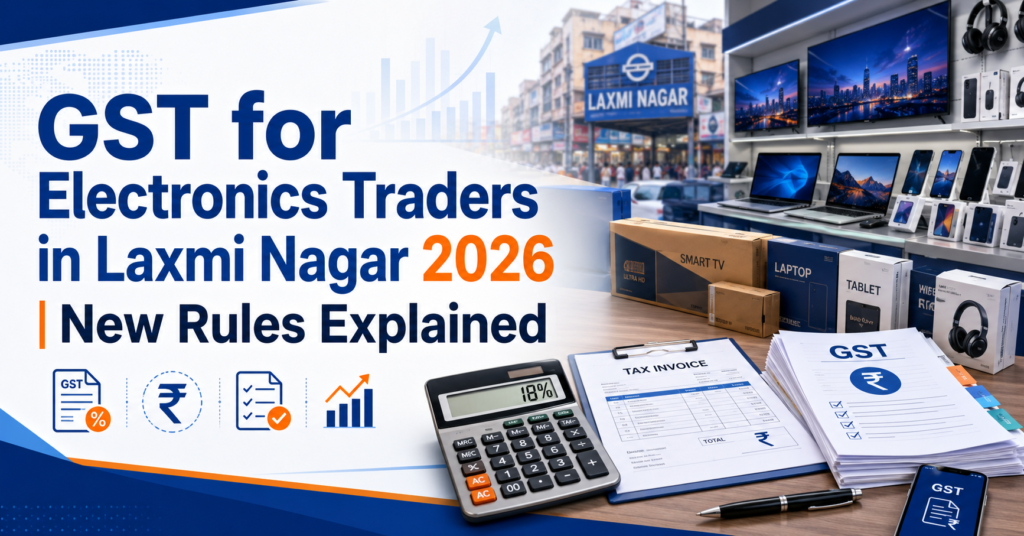

GST for Electronics Traders in Laxmi Nagar 2026 | New Rules Explained
If you are dealing in mobile phones, laptops, LED TV, chargers or any other electronic gadgets and accessories from a retail outlet in Laxmi Nagar, then here are some of the recent GST updates that have directly impacted your bottom-line and documentation processes. Laxmi Nagar is one of the leading electronics trading hubs of Delhi. Take a drive down Vikas Marg, or step into the alleyways of Shakarpur, and you will find hundreds of electronics traders whose day-to-day operations have undergone a sea-change in light of the newly applicable e-invoicing limits, HSN compliance rules and input tax credit matching norms.
This guide explains what has been changed in 2026 and how it will affect your business in Laxmi Nagar.
What is the new GST rule for electronics traders in Laxmi Nagar in 2026?
Three major changes that have been introduced in 2026 include: (1) the mandatory applicability of e-invoicing for turnover above Rs. 5 crore (down from Rs. 10 crore); (2) compulsorily inclusion of 6-digit HSN code on every B2B invoice for turnover above Rs. 5 crore and 4-digit HSN for all; and (3) strict linkage between ITC and supplier’s filing of GSTR-1 returns, which means no ITC if your supplier fails to file his/her return. Mobile phone traders (HSN 8517) and laptop traders (HSN 8471) under 18% GST slab face the maximum impact due to new GST rules.
What is GST for Electronics Traders?
GST for electronics traders is basically the same Goods and Services Tax as for any other business, but it applies special provisions for sectors based on certain HSN codes, rates and other compliance requirements. Certain types of electronic goods are taxable under different rates. Consumer electronics including mobile phones, laptops, TVs larger than 32 inches, audio equipment and some other products are taxed at 18%. Some smaller parts and accessories may vary.
When you buy stock from a distributor within Delhi region and resell it to walk-in clients or other resellers, you pay GST at the input stage and collect GST at the sales stage. The difference is your net payment to the government, minus ITC.
Why Does GST for Electronics Traders Matter in 2026 for Laxmi Nagar?
Laxmi Nagar is not a small residential market. Vikas Marg alone has hundreds of electronics traders with turnover from few lakhs to many crores per annum. Many of them have been using the same GST process since 2018 without updating according to newer notifications. All changes that have been introduced during the years 2023, 2024, 2025 have accumulated. In 2026, not only the notifications have increased, but also the enforcement mechanisms became more effective. Officers from your region conduct ITC verification checks, while AI-based mismatch alerts from the GST portal catch errors which used to go unnoticed before.
For an electronics trader in Laxmi Nagar, the risks are not limited to fines and penalties. It is mainly about the loss of input tax credit on thousands of rupees worth of stock, which reduces your margin on expensive electronic gadgets like laptops and premium mobile phones, where ITC constitutes a large part of the working capital cycle.
Three Major Changes in GST for Electronics Traders 2026
Change 1: E-Invoicing Limit Reduced to Rs. 5 Crore
E-invoicing requires you to generate every B2B invoice through the government portal called Invoice Registration Portal (IRP). It generates an IRN (Invoice Reference Number) and QR code for every invoice. Only invoices with IRN are recognized as legal B2B invoices for GST purposes.
Previously, until 2023, the e-invoicing threshold was set to Rs. 10 crore. It was then lowered to Rs. 5 crore. Many mid-size wholesalers and B2B suppliers of Laxmi Nagar are now included in the scope of the obligation. If your annual turnover in the previous financial year exceeds Rs. 5 crore, you must apply e-invoicing to all of your B2B transactions.
What this change entails for you: you will have to connect your accounting software to the IRP.
Printed Tally invoices without IRN can no longer be treated as legal B2B invoices. They will not be eligible for ITC, and your client will refuse to accept them.
Change 2: HSN Codes on Every Invoice
HSN (Harmonized System of Nomenclature) codes classify goods for tax purposes. In 2026, the reporting rules are:
Turnover | HSN Digits Required | On Which Invoices |
Up to Rs. 5 crore | 4-digit HSN | All B2B invoices |
Above Rs. 5 crore | 6-digit HSN | All B2B and B2C invoices |
For electronics traders, the most commonly used HSN codes are:
• 8517 — Mobile phones and telephone equipment (18% GST)
• 8471 — Computers, laptops, and data processing machines (18% GST)
• 8528 — Television sets and monitors (18% GST)
• 8518 — Speakers, headphones, and audio equipment (18% GST)
• 8504 — Chargers, adapters, and power supplies (18% GST)
• 8523 — Memory cards, pen drives, and storage media (18% GST)
Putting a wrong HSN on an invoice does two things: your buyer’s ITC gets flagged, and your GSTR-1 filing shows a mismatch. Both create audit exposure.
Change 3: Auto-locking of Input Tax Credit to Supplier Filing
This is the worst change. Till recently, as long as you had a valid tax invoice from your supplier, you could claim ITC even if your supplier had not filed their GSTR-1 for the month. Provisional credit used to work, which was then matched later.
Starting 2024, and with more stringency by 2026, now, ITC can be claimed only for the invoices that appear in your GSTR-2B, which is generated from your suppliers’ GSTR-1 filings. In case your supplier does not file their GSTR-1, or files it late, that invoice would not appear in your GSTR-2B, and you would not be able to claim the ITC.
For a Laxmi Nagar electronics trader buying stock worth Rs. 10 lakh a month at 18% GST, this is Rs. 1.8 lakh of ITC that goes in limbo if the supplier lags behind. Per quarter, that is Rs. 5.4 lakh of working capital tied up.
Benefits of Ensuring Compliance with GST Rules in 2026
• Complete input tax credit available on time, allowing your working capital to remain free.
• No mismatch notices from the GST department.
• Clean accounts making loan approval and onboarding vendors easy.
• Fast refunds for exports (if you sell to buyers outside India).
• Able to on-board larger corporate buyers that audit GST compliance of their vendors.
• Low risk of seizures of e-way bills while moving stock between states.
GST for Electronics Traders : Steps You Need To Follow
Step 1: Review Your Turnover
Take the turnover details of the past three financial years. If your any of these turnovers have crossed Rs. 5 crore, mandatory e-invoicing kicks in. No need to wait for the GST department to notify you.
Step 2: Update Your GST Billing Software
Ensure that your accounting software (Tally, Busy, Marg, Zoho, or other GST software) is integrated to the Invoice Registration Portal. If you do manual billing, switch to GST billing now.
Step 3: Audit Your HSN Codes
Take your product master list. Check all HSN codes against the 2026 CBIC classification list. Fix any four-digit codes to six-digit where required, based on your turnover band.
Step 4: Vet Your Suppliers
Take a list of your 20 top suppliers based on value of purchases. See their GSTR-1 filing history on the GST portal. If any of them lag behind in GSTR-1 filing each month, get them to fix it or buy from compliant suppliers.
Step 5: Crosscheck GSTR-2B Monthly
On 14th of each month, take your GSTR-2B. Cross-check it with your purchase register. Follow up with your supplier on any missing invoices before filing your GSTR-3B by 20th.
Step 6: Create e-Way Bills Discipline
For any consignment above Rs. 50,000 leaving Delhi, generate e-way bill before shipment. Enforcement in Delhi-Ghaziabad and Delhi-Noida corridors has tightened. Increased checkpoints for vehicles.
Common Mistakes to Avoid for GST for Electronics Traders
- Crossing the threshold does not require an official notice regarding e-invoicing.
- Assigning a same HSN code to all electronics. For instance, mobile chargers, phones and televisions have separate codes despite belonging to the electronics category.
- Filing a claim for ITC based on the invoice of the supplier, yet not verified in GSTR-2B. If the transaction is not reflected there, then it cannot be claimed as ITC.
- Ignoring the requirement to issue an e-way bill for the transport of goods within Delhi above Rs. 50,000.
- Late filing of GSTR-1. It will negatively impact the ITC of your buyers and lead to loss of customers.
- Not issuing a credit note when returning a laptop or a mobile phone. You need to process the return through GST procedures rather than ledgers alone.
GST for Electronics Traders – Innovative Taxation
We collaborate with more than 40 electronics traders in Laxmi Nagar, Nirman Vihar, and Preet Vihar. The most destructive trend we notice among those who trade in 2026 is choosing suppliers of cheaper goods which file their GSTR-1 quarterly or late. The difference in Rs. 500 in favor of the cost of purchasing per unit gets lost due to Rs. 3,000 blocked ITC of the Rs. 20,000 mobile phone. Check their filing record, not only price.
Statistics & Trends (2026) on GST for Electronics Traders
• More than Rs. 4 lakh crore of the GDP is contributed by the electronics retail industry in India by 2026, while Delhi NCR accounts for 15% of them.
• The threshold for e-invoicing has been lowered four times since 2020 (from Rs. 500 crore to Rs. 5 crore).
• Up to 12% of the ITC claims of small electronics dealers are highlighted by AI-based GST mismatch system.
• The average period of resolving mismatches in GSTR-2B is 20 to 30 days in case the supplier cooperates.
• The number of e-way bill checkpoints in Delhi NCR has increased by more than 30% between 2023 and 2026.
Comparison Table: Old Rules vs 2026 Rules
Area | Earlier Rule (2022-23) | 2026 Rule |
E-invoicing threshold | Rs. 10 crore turnover | Rs. 5 crore turnover |
HSN digits (up to Rs. 5 cr) | 2-digit HSN | 4-digit HSN mandatory |
HSN digits (above Rs. 5 cr) | 4-digit HSN | 6-digit HSN mandatory |
ITC eligibility | Provisional ITC allowed | Only what appears in GSTR-2B |
E-way bill enforcement | Moderate | Strict, more checkpoints |
Supplier default impact | Buyer could still claim ITC | Buyer loses ITC that month |
Frequently Asked Questions
GST rate of mobile phones in 2026?
The GST on mobile phones is 18 percent according to HSN 8517. This includes all smartphones and feature phones being sold in India.
E-invoicing for my turnover of Rs. 4 crore?
Only if your total annual turnover since FY 2017-18 exceeds Rs. 5 crore, you have to implement e-invoicing. Watch this limit because this could come down in future amendments.
ITC on invoices without GSTR-1 filing by my supplier?
If your supplier has not filed his GSTR-1 for a particular period, you cannot claim ITC since it is only available for invoices in your GSTR-2B.
What HSN code do I use for laptop chargers?
Typically, laptop chargers and power adapters come under the category of HSN 8504 (at 18% GST). Verify against the latest CBIC classification for your product.
Is it necessary to create a current account prior to GST registration?
Yes. Since 2023, GST portal allows you to update your bank account details within 45 days from the date of registration or before filing your first return whichever is earlier.
What should be the size of the photo?
JPEG format and under 100KB. Almost all phone cameras photos come in very large size. Therefore, one should use a free online image compressor for compressing the image.
Is it necessary to create a current account prior to GST registration?
No. You can get it created before filing the first GST return.
My address has been changed since I applied. What do I do now?
File form GST REG-14 to update your address in your GSTIN. Along with new address proof you have to send the form and generally the process takes 15 working days.
Can I register a GSTIN for a home-based business?
Yes. Home based businesses can get registered by providing their residential address as the principal place of business. You have to provide the electricity bill of your residence and consent letter in case the property is in any of your family member’s name.