

ITR-1 vs ITR-4: Should You File ITR-1 Or ITR-4?
When filling an Income Tax Return (ITR), taxpayers sometimes face challenges with choosing the proper form. Many taxpayers are confused about whether they should use ITR-1 or ITR-4.
As it turns out, these two ITR forms serve very different taxpayers and should not be mixed up.
The choice of the ITR form is determined by residential status, income sources, total income, and business/professional income.
For the Assessment Year 2026-27, the Income Tax Department of India provides the specific requirements and rules for filing ITR-1 (Sahaj) and ITR-4 (Sugam).
The difference in the usage of these ITR forms lies in the taxpayer’s residence, income profile, and some other factors.
Using the wrong ITR form will lead to compliance issues and require corrections to the return.
In this article, we discuss the difference between ITR-1 and ITR-4, list taxpayers who are eligible for ITR-1/ITR-4, and also specify the conditions when you cannot use these forms.
Then, we provide some examples of typical ITR-1 and ITR-4 taxpayers, as well as a step-by-step guide for choosing the right form.
What Is ITR-1?
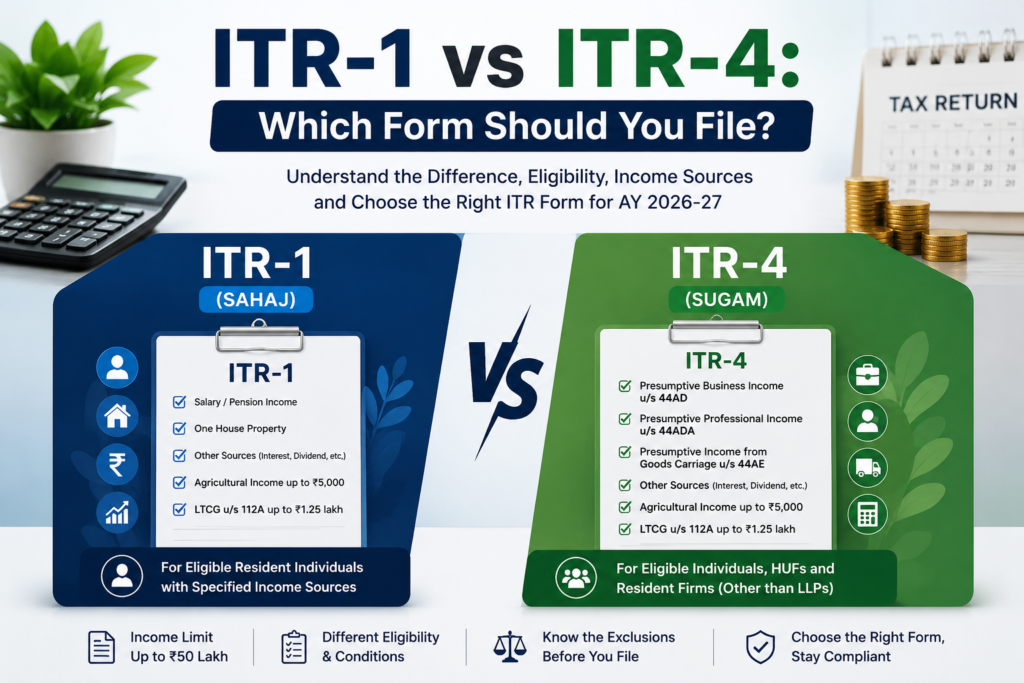
ITR-1, or Sahaj, is a simplified ITR form for eligible resident individuals.
For Assessment Year 2026-27, the Income Tax Department of India allows using ITR-1 to a resident individual, who is not Not Ordinarily Resident (RNOR), with total income up to ₹50 lakh and whose income is included in the following types of income:
Income from salary or pension;
Income from one eligible house property;
Income from other sources including interest, family pension, and certain types of dividends;
Agricultural income up to ₹5,000;
Income from Section 112A long-term capital gains up to ₹1.25 lakh under the applicable conditions.
The Income Tax Department specifies several exclusions for using ITR-1.
Simply put, the form is mostly suitable for taxpayers with a straightforward income profile and without business/professional income that requires another ITR form.
Example Of A Typical ITR-1 Taxpayer
Let’s assume that Rahul is a salaried individual living and working in Delhi.
His income consists of:
Salary;
Interest from savings account;
Interest from fixed deposit;
Income from one house property.
In this case, if his total income is below ₹50 lakh and all other conditions are satisfied, he may be eligible to use ITR-1.
What Is ITR-4?
ITR-4 or Sugam is an ITR form for eligible resident individuals, HUFs and certain resident firms other than LLPs that use the presumptive taxation rules for business or professional income.
For the Assessment Year 2026-27, ITR-4 is used to declare income covered by Sections 44AD, 44ADA and 44AE of the Income Tax Act, as well as other specified sources of income.
According to the guidelines of the Income Tax Department, the total income should generally be up to ₹50 lakh, subject to the conditions and rules applicable to the particular taxpayer.
ITR-4 can be used by certain:
Small business owners;
Eligible professionals;
Freelancers;
Individuals who use presumptive taxation;
Eligible resident HUFs;
Certain resident firms other than LLPs.
For example, an eligible freelancer who is able to declare his/her professional income under Section 44ADA may be eligible to use ITR-4, provided that he/she meets all other conditions.
Example Of A Typical ITR-4 Taxpayer
Let’s assume that Priya works independently as an eligible professional.
She receives her professional income during the year and decides to use presumptive taxation scheme under Section 44ADA, provided that she meets all applicable conditions.
In this case, she may be able to use ITR-4, if all other conditions are satisfied.
The important point is that the existence of business or professional income does not necessarily mean that ITR-4 is the correct form.
It depends on the way how the income is computed and other circumstances of the taxpayer.
ITR-1 vs ITR-4: Main Difference
The key difference between these two forms is in the type of income they are designed to cover.
ITR-1 is primarily for eligible resident individuals with specified sources of income such as salary, pension, house property and other.
ITR-4 is for eligible individuals/HUFs/firms who have business or professional income under the specified presumptive taxation provisions.
Here is a brief comparison:
ITR-1 vs ITR-4 Comparison Table
Feature
ITR-1
ITR-4
Common name
Sahaj
Sugam
Main users
Eligible resident individuals
Eligible individuals, HUFs and resident firms other than LLPs
Business/professional income
Generally not applicable
Yes, under eligible presumptive taxation provisions
Total income limit
Generally up to ₹50 lakh
Generally up to ₹50 lakh
Salary/Pension
Yes
Yes, subject to eligibility
House property income
Eligible specified property income
Eligible specified property income
Other sources
Yes, subject to conditions
Yes, subject to conditions
Presumptive business income
No
Yes
Presumptive professional income
No
Yes
Agriculture income
Up to ₹5,000, subject to conditions
Up to ₹5,000, subject to conditions
Section 112A LTCG
Up to ₹1.25 lakh, subject to conditions
Up to ₹1.25 lakh, subject to conditions
The exact eligibility rules and exclusions should always be checked for the particular Assessment Year, as tax forms and requirements may be changed.
Who Should File ITR-1?
ITR-1 may be suitable if you meet the prescribed conditions and have eligible sources of income.
Typical eligible taxpayer has:
1. Salary or Pension Income
If you are a salaried individual or a pensioner and satisfy other conditions, you may be eligible for ITR-1.
Your salary information can usually be provided by Form 16 and your tax documents.
But having the salary income alone does not guarantee that ITR-1 is the correct form.
You also need to check your residential status, total income and other sources of income.
2. Income From an Eligible House Property
Eligible taxpayers can report their income from the specified house property category in ITR-1.
The rules regarding the number and nature of house properties are important for some taxpayers and they should check whether ITR-1 is still eligible.
3. Interest and Other Eligible Sources
Interest income from savings accounts and deposits can fall within the scope of the income categories covered by ITR-1.
It is especially important for salaried taxpayers who receive additional interest from financial institutions in addition to salary income.
4. Certain Dividend Income
Eligible dividend income can fall into the “Other Sources” category, subject to the conditions.
5. Certain Section 112A Long-Term Capital Gains
For Assessment Year 2026-27, the Income Tax Department specifies that eligible taxpayers can have Section 112A long-term capital gains up to ₹1.25 lakh while using ITR-1, subject to the conditions.
This is important, as many taxpayers think that having the capital gain automatically makes them ineligible for ITR-1.
The actual type and amount of capital gains are important.
Who Should File ITR-4?
The main use of ITR-4 is when an eligible taxpayer has business or professional income declared according to the presumptive taxation provisions.
1. Small Business Owners
Certain eligible small businesses can use the presumptive taxation scheme under Section 44AD.
If a taxpayer satisfies the applicable conditions, he/she may be able to use ITR-4.
2. Eligible Professionals
Certain eligible professionals can use the presumptive taxation scheme under Section 44ADA.
In case the professional is eligible and uses presumptive taxation and satisfies other conditions, ITR-4 may be the appropriate ITR form.
3. Eligible Transport Operators
Certain taxpayers, eligible under Section 44AE, can use the presumptive taxation scheme while plying, hiring or leasing goods carriages, subject to the conditions.
Eligible taxpayers using this provision can use ITR-4.
4. Freelancers
Very often freelancers are wondering what ITR to choose – ITR-1 or ITR-4.
The answer depends on the nature of their income and the way it is taxed.
If an eligible freelancer has the professional income and uses presumptive taxation under Section 44ADA, ITR-4 may be applicable, provided that other conditions are satisfied.
Otherwise, another form may be needed.
When You Cannot Use ITR-1
It is as important to know the exclusions as to learn about the conditions of using a tax form.
For Assessment Year 2026-27, the Income Tax Department of India specifies several conditions that will make a person ineligible for ITR-1.
These are:
Taxpayer is Non-resident or RNOR;
Total income is above ₹50 lakh;
Short-term capital gains;
Section 112A long-term capital gains exceeding ₹1.25 lakh;
Taxpayer holds unlisted equity shares during the relevant previous year;
Taxpayer is a director in a company;
Taxpayer has foreign assets or foreign income;
Signatory authority in the account situated abroad;
Certain ESOP-related situations;
Certain brought-forward or carried forward losses situations; and
Other conditions.
The exact exclusions should be checked according to the rules for the particular assessment year.
This is why simply saying “I am a salaried person, so ITR-1 is enough for me” can be misleading.
Your salary is just one condition of the eligibility test.
When You Cannot Use ITR-4
The ITR-4 has its own exclusions too.
For Assessment Year 2026-27, ITR-4 cannot generally be used in the following circumstances:
Taxpayer is RNOR or Non-Resident;
Total income exceeds ₹50 lakh;
Taxpayer has short-term capital gains;
Section 112A long-term capital gains exceed ₹1.25 lakh;
Agricultural income exceeds ₹5,000;
Taxpayer is a director in a company;
Taxpayer has held unlisted equity shares during the relevant previous year;
Foreign assets or foreign income;
Certain ESOP tax deferral situations;
Special-rate income;
More than two house properties.
This is the list of the restrictions for ITR-4 for Assessment Year 2026-27, as specified by the Income Tax Department of India.
So, even if you have your presumptive business income, you should not think that you can use ITR-4.
Can a Salaried Person Use ITR-4?
Yes, in certain circumstances.
This is one of the most common misinterpretations.
ITR-4 is not limited to taxpayers having only the business income.
An eligible individual can have salary/pension income along with eligible presumptive business or professional income and file ITR-4, provided that all conditions are satisfied.
For example:
Taxpayer works as an employee for a company and also has the eligible side business.
If the business income is eligible for presumptive taxation and the taxpayer meets the other ITR-4 conditions, he/she may be able to use ITR-4.
The main point is not simply the presence of the salary.
It is the complete income profile and conditions.
Can a Freelancer Use ITR-1?
A freelancer with genuine business or professional income should assess the nature of the income and the way it is taxed.
If the freelancer is eligible for presumptive taxation and decides to use it under Section 44ADA, then ITR-4 may be applicable.
If the freelancer does not satisfy the ITR-4 conditions, another ITR form may be necessary.
So, the simple rule is:
Freelancer does not automatically mean ITR-4.
You need to consider:
Nature of professional activity;
Way of taxation;
Total income;
Residential status;
Capital gains;
Foreign assets or income;
Other exclusions;
ITR-1 vs ITR-4 for Small Business Owners
Small business owners should pay attention to the difference.
Suppose you have a small eligible business and you want to use presumptive taxation under Section 44AD.
If you satisfy the applicable conditions, you can use ITR-4.
But if your income or other circumstances fall outside of the eligibility criteria, you will have to use another ITR form.
This is why small business owners should not choose an ITR form only based on their annual turnover.
The correct ITR form depends on the complete tax profile.
ITR-1 vs ITR-4 for Professionals
Professionals may also have to be careful.
Eligible professionals using Section 44ADA may be able to use ITR-4.
But professionals who are not eligible for ITR-4 may have to use ITR-3 form, depending on their circumstances.
For example, a professional who has complex business records, capital gains, foreign assets, or excluded income may not be eligible for ITR-4.
This is the important distinction.
ITR-4 is a simplified form for eligible presumptive taxation cases, not a universal form for any self-employed person.
What Is Presumptive Taxation?
In order to understand ITR-4, you should understand the basics of the presumptive taxation.
Presumptive taxation allows eligible taxpayers to compute their taxable income from business or profession according to the prescribed presumptive rules and not according to regular computation.
The main goal is to facilitate compliance for eligible taxpayers.
The three main sections, related to ITR-4 are:
Section 44AD
It refers to presumptive taxation of certain eligible businesses.
Section 44ADA
It refers to presumptive taxation of certain eligible professionals.
Section 44AE
It refers to certain business activities involving goods carriages, subject to the relevant conditions.
The Income Tax Department specifies Sections 44AD, 44ADA and 44AE in the eligibility criteria for ITR-4.
Simple Examples: ITR-1 or ITR-4?
Let’s simplify the difference between ITR-1 and ITR-4.
Example 1: Salaried Individual
Amit has:
Salary income;
Income from bank interest;
One eligible house property;
Total income below ₹50 lakh;
No business income;
No disqualifying capital gains or foreign assets.
Likely form: ITR-1, subject to other eligibility conditions.
Example 2: Salaried Individual with Eligible Side Business
Neha has:
Salary income;
Interest income;
Eligible business income;
Uses presumptive taxation under Section 44AD;
Meets all ITR-4 conditions.
Likely form: ITR-4.
Example 3: Eligible Professional
Rahul is an eligible professional and declares professional income under Section 44ADA.
Also, he meets all other ITR-4 conditions.
Likely form: ITR-4.
Example 4: Salaried Individual With Short-Term Capital Gains
Sonia has salary income and short-term capital gains.
Even if her total income is below ₹50 lakh, the presence of short-term capital gains can make ITR-1 and ITR-4 unusable.
Likely form: Applicable ITR form other than ITR-1 and ITR-4, e.g., ITR-2.
Example 5: Business Owner with Complex Income
Vikram has business income but does not satisfy the conditions for ITR-4.
He may need to file ITR-3 depending on his circumstances.
Lesson is clear:
Just the source of your income does not define the ITR form.
Common Mistakes While Choosing ITR-1 or ITR-4
There are many mistakes made by taxpayers every year.
Choosing ITR-1 Just Because You Are Salaried
Being salaried does not automatically mean you are eligible for ITR-1.
You need to check all your income sources and the exclusions.
Choosing ITR-4 Just Because You Are a Freelancer
Being a freelancer does not automatically mean ITR-4.
You need to determine whether your professional income qualifies for presumptive taxation and whether you meet other conditions.
Ignoring Capital Gains
Some taxpayers focus on salary or business income and ignore the capital gains from investments.
Capital gains can influence which return form you need.
Ignoring Foreign Assets
Foreign bank accounts, foreign assets, foreign income and other related circumstances can influence the ITR-1 and ITR-4 eligibility.
Looking Only at Total Income
The ₹50 lakh threshold is important, but it is not the only condition.
Even if your income is below ₹50 lakh, other condition may render you ineligible.
How to Choose Between ITR-1 and ITR-4
The simple decision algorithm can help.
Step 1: Check Your Residential Status
Firstly, you need to identify your residential status and whether you fall within the required category.
ITR-1 and ITR-4 have specific restrictions regarding the residential status.
Step 2: Check Your Total Income
Check whether your total income falls within the applicable ₹50 lakh threshold.
Step 3: List out all your sources of income.
Sources of income:
Salary
Pension
House property
Interest
Dividend
Business income
Professional income
Capital gains
Agricultural income
Foreign income
Step 4: Is there any presumptive taxation?
Check if your business or professional income has been calculated under eligible presumptive taxation.
If yes, then ITR-4 may be applicable.
Step 5: See the exclusions list
Is there any exclusion in your case like
Short-term capital gains
Certain foreign assets
Foreign income
Unlisted equity shares
Directorship in a company
Certain losses
And other disqualifying conditions.
Step 6: Try Income Tax Department’s ‘help me decide’ service
This is a service provided by the Income Tax Department to help individual taxpayers to know what ITR form is applicable in their case, depending upon qualifying conditions.
The service is available from Assessment Year (AY) 2020-21 and will help taxpayers identify the form and schedule they need to file their returns.
Why choosing the Correct ITR Form is Important?
There is more than just formality involved in choosing the right ITR form.
Your return should reflect your income and your circumstances properly.
Choosing the wrong ITR form may lead to
Defective return notices
Need for correction and revision
Additional work
Delay in processing
Unnecessary confusion
This does not mean that taxpayers need to panic while filing.
They just need to spend some time understanding eligibility requirements of the forms before filing.
Professional tax advisory will be helpful in complex cases.
ITR-1 vs ITR-4: Which ITR form should I file?
It depends upon your personal circumstances.
File ITR-1 if
You are an eligible resident individual with specified income like:
Salary or pension
Eligible income from house property
Eligible income from other source
Agricultural income in the prescribed limit
Eligible Section 112A long-term capital gains in the prescribed limit
Without having any disqualifying conditions.
Think of filing ITR-4 if
You are an eligible individual, HUF or qualifying resident firm with eligible business or professional income computed under presumptive taxation provisions such as:
Section 44ADA
Section 44AE
Along with satisfying all other eligibility conditions for ITR-4.
You may need to file other ITR form if
Your income or your circumstances do not fall in the eligibilities of either of the two forms above.
This is true for certain taxpayers who may have capital gains, business income falling outside presumptive provisions, foreign assets or other complex income sources.
Frequently Asked Questions
1. What is the main difference between ITR-1 and ITR-4?
ITR-1 form is normally applicable to the eligible individuals having the specified sources of income like salary, pension, income from eligible house property, etc. The ITR-4 form is normally applicable to the eligible taxpayers having the presumptive business/profession income under the provisions like Section 44AD, 44ADA & 44AE.
2. Can a salaried person file ITR-4?
Yes, since there can be some chances where a salaried individual may file the return of ITR-4 provided he fulfills the requirements of presumptive taxation and meets all other criteria for filing ITR-4.
3. Can a freelancer file ITR-1?
An individual who earns business income needs to find out whether he falls into the category of filing ITR. If he is eligible for presumptive tax under Section 44ADA, then ITR-4 can be relevant.
4. What is the income limit for ITR-1 and ITR-4?
For the year 2026-27, the gross total income limit for ITR-1 and ITR-4 is ₹50 lakhs, but this limit is conditional on meeting certain qualifications.
5. Can I file ITR-4 if I have salary income?
Certainly, as long as the criteria for filing ITR-4 are met. Income from salary or pension may be shown in addition to presumptive business income.
6. Can ITR-1 be used if I have capital gains?
It would depend on whether capital gains are eligible Section 112A long-term capital gains within a particular ceiling. In case of AY 2026-27, there are some eligible Section 112A long-term capital gains that are up to ₹1.25 lakh that may be reported by way of ITR-1.
7. Which ITR form should a small business owner use?
If an eligible small businessman uses presumptive tax system under Section 44AD, he/she might be able to use ITR-4, assuming that he/she meets all other criteria. If the person is not eligible for ITR-4, then another form of ITR might be needed.
8. Which ITR form should professionals use?
Professional persons opting for presumptive taxation as per Section 44ADA may use ITR-4. Other professionals that are not eligible to use ITR-4 have to use some other form like ITR-3.
9. What happens if I choose the wrong ITR form?
The use of an incorrect ITR will lead to complications such as issuance of a defective return notice or revision/rectification of the return. Thus, one needs to verify his/her eligibility for using a certain ITR.