
TDS Return Due Date October 2026: New Forms 138, 140 & 144 Explained
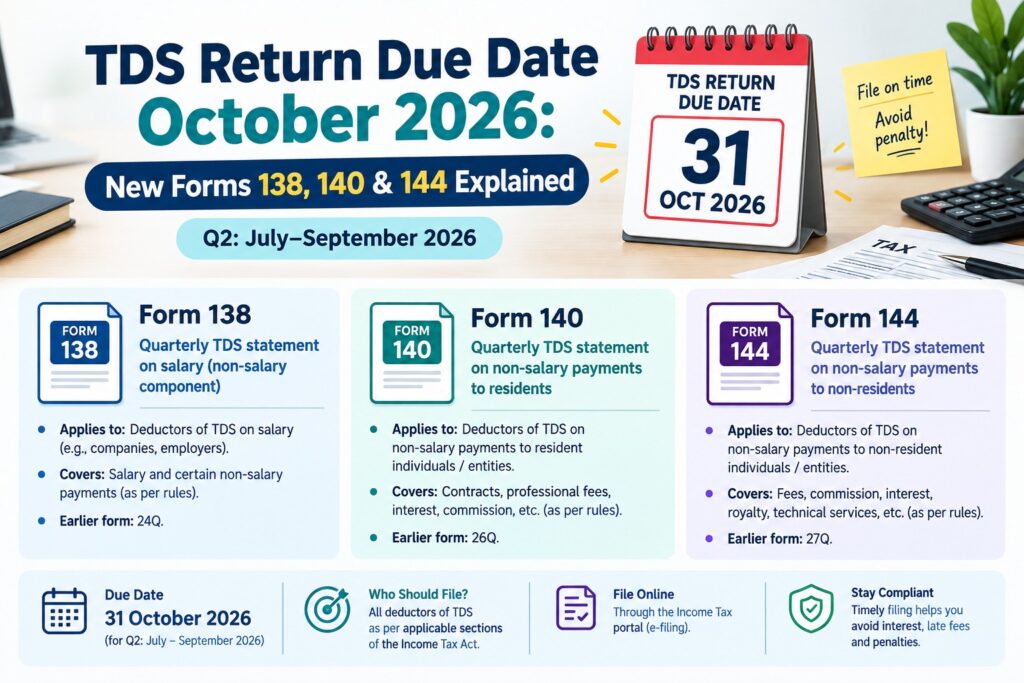
If you deduct tax at source, October is a busy month. The TDS return due date October 2026 falls on 31 October, and this year there is an extra twist: the familiar forms 24Q, 26Q and 27Q now carry new numbers under the Income-tax Act, 2025.
Many deductors are still searching for the old form names, and that is where mistakes begin. This guide explains the TDS return due date October, what Forms 138, 140 and 144 are, who files which form, the late fee for missing the deadline, and a simple checklist to finish on time.
TDS Return Due Date October 2026 at a Glance
The Q2 TDS statement covers deductions made from 1 July 2026 to 30 September 2026. It must be filed by 31 October 2026.
Here is the full schedule for the year:
| Quarter | Period covered | Return due date |
|---|---|---|
| Q1 | April to June 2026 | 31 July 2026 |
| Q2 | July to September 2026 | 31 October 2026 |
| Q3 | October to December 2026 | 31 January 2027 |
| Q4 | January to March 2027 | 31 May 2027 |
The quarterly dates are the same as before. What has changed is the form numbers and the legal framework behind them.
Why Did the TDS Form Numbers Change?
The Income-tax Act, 2025 and the Income-tax Rules, 2026 came into effect from 1 April 2026. Along with the new law, the Income Tax Department renumbered many forms and simplified their language and layout.
For TDS events from 1 April 2026 onward, the new Act applies. For credits or payments made on or before 31 March 2026, the old framework still applies. This matters if you are reporting older transactions, so check which Act governs each entry.
The New Forms: 138, 140, 143 and 144
Here is the quick conversion table every deductor should keep handy.
| Old form | New form | What it covers |
|---|---|---|
| Form 24Q | Form 138 | TDS on salary |
| Form 26Q | Form 140 | TDS on non-salary payments to residents |
| Form 27Q | Form 144 | TDS on payments to non-residents |
| Form 27EQ | Form 143 | Tax collected at source (TCS) |
The purpose of each statement is unchanged. Only the numbering and format are new.
Form 138: Salary TDS Return
Form 138 replaces Form 24Q. Employers use it to report tax deducted on salary, including certain income of specified senior citizens. It is filed under Rule 219 of the Income-tax Rules, 2026, and has Part A, Part B and annexures. If you run payroll, this is your quarterly return.
Form 140: Non-Salary TDS Return for Residents
Form 140 replaces Form 26Q. It covers TDS on payments other than salary made to resident deductees, such as:
- Professional and technical fees
- Contractor payments
- Rent
- Commission and brokerage
- Interest (other than on securities, where applicable) and similar payments
Any person liable to deduct tax on such payments to residents files this form every quarter.
Form 144: TDS on Payments to Non-Residents
Form 144 replaces Form 27Q. If you pay a non-resident or a foreign company, for example for software services, royalties, fees for technical services or interest on foreign borrowings, the tax deducted is reported here. A common mistake is putting such payments in Form 140. Resident deductees go in Form 140, and non-resident deductees go in Form 144.
Form 143 and Form 141
Two more forms are worth knowing:
- Form 143 replaces Form 27EQ and is used for the quarterly TCS statement.
- Form 141 is a consolidated challan-cum-statement under the new Act. It brings together what used to be separate challan-cum-statements (such as for TDS on property purchase and rent paid by individuals), so single-transaction deductors should look for it.
TDS Deposit Date vs TDS Return Date
These two dates are often confused, so keep them separate:
- TDS deposit: Tax deducted in a month must generally be deposited by the 7th of the following month. For September 2026 deductions, that date is 7 October 2026.
- TDS return: The quarterly statement is filed by the dates in the table above. For Q2, it is 31 October.
Deposit the tax first, then file the return. The challan details in your statement must match the deposits, or the return will show defaults.
Related Deadlines After the Q2 Return
Once the Q2 return is filed, certificates follow:
- Non-salary TDS certificate (earlier Form 16A): to be issued within 15 days of the quarterly return due date. For Q2, that means around mid-November.
- Salary TDS certificate (earlier Form 16): issued once a year, by 15 June after the end of the financial year, under the new numbering as Form 130.
Because the certificate is generated from the TDS statement, any delay or error in the return directly delays the certificate for your vendors and employees.
What Happens If You Miss the TDS Return Due Date?
Late filing is expensive, so it is worth avoiding.
1. Late filing fee. For tax year 2026-27, Section 427 of the Income-tax Act, 2025 provides a fee of ₹200 per day for the period of delay. The total fee cannot exceed the amount of tax deductible or collectible during that statement.
Example: If the Q2 return due on 31 October is filed on 20 November, the delay is 20 days, so the fee is 20 × ₹200 = ₹4,000, provided this stays within the TDS amount for that statement.
2. Penalty for continued default. Under the earlier regime, a further penalty of ₹10,000 to ₹1,00,000 applied if the return was not filed within the prescribed time. That penalty was not imposed where the return was filed within one year of the due date and all tax, interest and fees were paid. Confirm the position under the new Act with your advisor before relying on it.
3. Interest. Interest applies if tax is not deducted (at 1% per month) or deducted but not deposited (at 1.5% per month), calculated for the period of default.
4. Disallowance. Certain expenses on which TDS was not deducted or deposited on time can face a partial disallowance in your own income computation.
5. Credit problems for deductees. If the return is late or wrong, the deductee’s Form 26AS and Annual Information Statement may not show the tax credit, which leads to complaints and follow-up from vendors and employees.
Step-by-Step Checklist Before 31 October
Use this list to finish your Q2 return calmly.
- Confirm which forms you need. Salary only: Form 138. Resident non-salary: Form 140. Non-resident payments: Form 144. TCS: Form 143.
- Collect deduction data. Keep PANs, amounts paid, dates of payment or credit, tax deducted, and section details ready for July, August and September.
- Verify PANs. Wrong or missing PANs lead to higher-rate deduction and credit mismatches.
- Match challans. Ensure that every deposit (BSR code, date and serial number) is correctly linked to the statement.
- Check the correct Act applies. For entries with credit or payment on or before 31 March 2026, the old framework governs.
- Prepare the statement. Use the offline utility or your TDS software to create the file for the relevant form.
- Validate the file. Run the File Validation Utility (FVU) and fix errors before uploading.
- Upload on the portal. Use the Income Tax e-filing portal route shown for your form, and verify with a digital signature or EVC.
- Download the filing receipt. Keep the acknowledgement and token number for your records.
- Track processing. After filing, check the default summary on TRACES and correct mismatches quickly.
Common Mistakes to Avoid
- Using the old form names while searching on the portal and picking the wrong utility
- Reporting non-resident payments in the resident form
- Treating the deposit date and the return date as the same
- Leaving challan mismatches until the last week
- Ignoring the 31 March 2026 cut-off between the old and new Acts
- Waiting until 31 October, when portal slowdowns are common
Tips for a Smooth Filing Season
- Reconcile monthly: Compare the books with TDS payable ledgers every month instead of every quarter.
- Keep PAN data clean: Maintain a vendor master with verified PAN and the correct section code.
- Use one owner: Assign one person to own TDS compliance, with a calendar reminder 10 days before each date.
- File early: Target 20 to 25 October so you have buffer for corrections.
Frequently Asked Questions
What is the TDS return due date October 2026?
The Q2 TDS return, covering July to September 2026, is due on 31 October 2026.
Which form replaces Form 24Q?
Form 138 replaces Form 24Q for salary TDS.
Which form replaces Form 26Q?
Form 140 replaces Form 26Q and is used for non-salary payments to residents.
Which form replaces Form 27Q?
Form 144 replaces Form 27Q and covers TDS on payments to non-residents.
What replaces Form 27EQ?
Form 143 replaces Form 27EQ for the TCS statement.
What is the late fee for filing a TDS return after the due date?
For tax year 2026-27, the late fee is ₹200 per day, capped at the amount of tax deductible or collectible.
Is the deposit date the same as the return date?
No. TDS is generally deposited by the 7th of the following month, while the quarterly return is filed by 31 July, 31 October, 31 January and 31 May.
Do the old Act rules still matter?
Yes. For credits or payments on or before 31 March 2026, the old framework applies, so the Act is decided transaction by transaction.
Final Thoughts
The TDS return due date October 2026 is straightforward: 31 October for Q2. The real challenge this year is the change in form numbers and the move to the new Act. Once you know that Form 138 is for salary, Form 140 is for resident non-salary payments and Form 144 is for non-residents, the process feels familiar. Reconcile early, validate carefully and file well before the last day to avoid late fees and credit issues for your vendors and employees.
Disclaimer: This article is for general information and does not replace professional advice. Please consult a qualified Chartered Accountant or tax professional for your specific situation.