
57th GST Council Meeting 2026: What Delhi Traders Should Expect
If you run a shop in Karol Bagh, a wholesale counter in Sadar Bazar, a showroom in Nehru Place or a small workshop in Shakarpur, you probably saw the same headline everywhere this week: “GST Council recommends removal of arrest powers.” And then your phone filled up with WhatsApp forwards, each saying something slightly different.
So let’s slow down and talk about what actually happened, what it means for a trader in Delhi, and what you should (and should not) do about it right now.
The Quick Answer
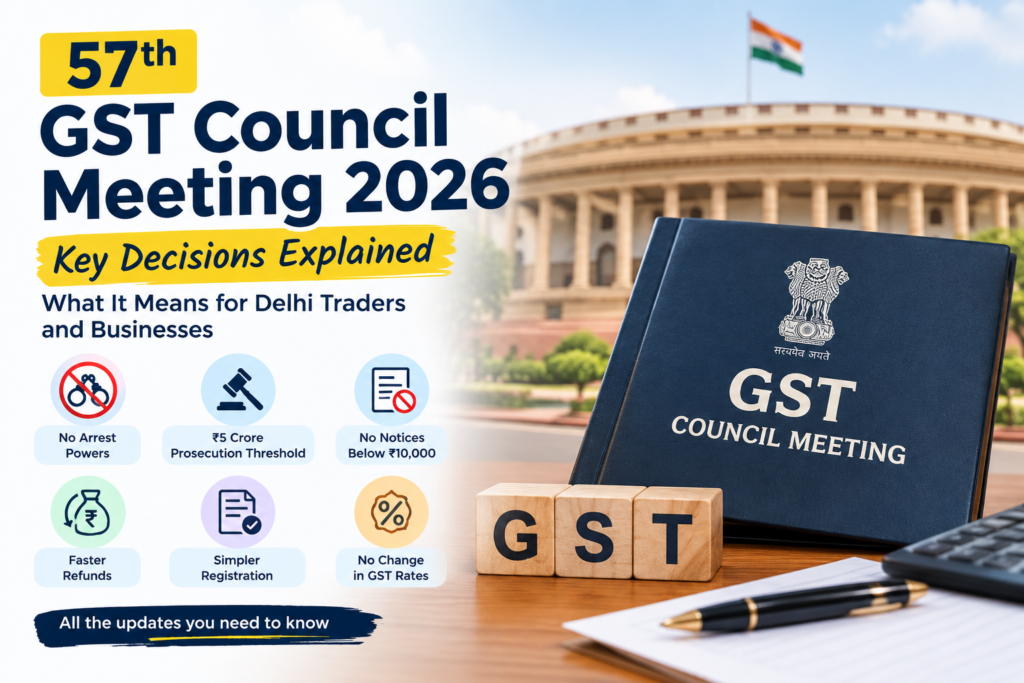
What did the 57th GST Council meeting decide? The Council, chaired by Union Finance Minister Nirmala Sitharaman, recommended a set of changes aimed at making GST less stressful: no arrest powers for tax officers, a higher prosecution threshold of ₹5 crore, no notices for tiny amounts of ₹10,000 or below, faster refunds, and simpler registration. GST rates were not changed.
Is it law already? No. These are recommendations. They become rules only after CBIC notifies them, or after Parliament amends the CGST Act where the Act itself has to change. Until then, today’s rules apply.
That one point saves a lot of panic, so keep it in mind as you read on.
First, the Good News: No Rate Shock
Let’s start with what did not happen. There was no change to GST rates. The 5% and 18% slabs, with 40% on demerit goods, came in on 22 September 2025, and the Council appears to want a full year of data before touching them again.
For a Delhi trader, that means your pricing, billing software and invoices stay as they are. You do not need to redo your price lists this month. That alone is a relief for anyone who remembers the confusion after the last rate overhaul.
The Big One: Arrest Powers and Prosecution
This is the headline most people noticed. The Council recommended deleting Section 69 of the CGST Act, which is the provision that allows arrest in specified GST offences. It also recommended raising the prosecution threshold from ₹1 crore to ₹5 crore, and leaving punishment (fine, imprisonment or both) to judicial discretion case by case.
What does that mean in plain language?
- The fear of an officer showing up at your door for a mismatch is expected to reduce.
- Late returns, honest mistakes and delayed payments are still not free. You would still face recovery, interest and proportionate penalties.
- Genuine fraud is a different story, and nobody is suggesting otherwise.
If you are a regular, honest trader who sometimes files late because the accountant was away or the portal was slow, this is meant for you. If you are in the habit of issuing bills without real supply, nothing here is a safe harbour.
Small Notices Are on Their Way Out
Many Delhi traders have had this experience: a notice arrives for a small difference, and suddenly you are collecting papers, paying a professional and taking time off the shop floor to fight a demand that is less than the cost of fighting it.
The Council recommended a minimum monetary threshold. Notices would not be issued for amounts of ₹10,000 or below, and pending notices below that limit would be withdrawn. It also recommended common standards for how notices and proceedings are handled, and a lower maximum general penalty of ₹10,000.
If this is notified as proposed, it could clear a good number of petty notices off a trader’s desk. But until the official notification, do not ignore any notice you receive. A notice that goes unanswered turns into an order, and an order is much harder to undo.
Refunds: Money Back Faster
For exporters and traders with accumulated credit, refunds are where cash flow gets decided. The Council recommended speeding up refunds, with provisional refunds of 90% and more automated processing. It also recommended removing the restriction under Rule 89(4)(C) that limits the turnover of zero-rated supplies of goods to 1.5 times the value of like goods supplied domestically.
Delhi has plenty of garment, handicraft, electronics-parts and leather-goods exporters in the NCR belt. If you are one of them, this is worth watching closely. Money stuck in refunds is money you cannot use to buy stock.
Same advice as before: when the rules are notified, check what documents the system expects. Faster refunds usually come with tighter data matching.
Registration Gets Simpler
If you have ever helped a relative start a small business, you know how painful GST registration can be. Rejections for unclear documents, queries on the address proof, and repeated back-and-forth on the portal are common.
The Council recommended a clearer circular on registration documents, a simpler registration application (REG-01) with document choices, and automatic acceptance of amendments to most registration details, subject to the rules. Cancellation is also expected to become easier to handle.
This is good news for small shops, online sellers and anyone planning to open a new outlet. If you are thinking of registering a new business in Delhi, the process may get lighter soon, but you can still go ahead with your registration now rather than waiting. Our GST registration guide for Delhi NCR walks through the current steps.
Input Tax Credit: Some Relief, Some Wait
ITC is the part every trader cares about, because it directly touches profit.
Here is what was recommended:
- Removing specified Section 17(5) restrictions on items such as health and life insurance and outdoor catering, among other categories
- Allowing dealers under the margin scheme for second-hand vehicles to claim ITC on eligible inputs and input services, other than the vehicles themselves
- Changes to blocked credit and accumulated ITC refunds in specified cases
And then there is the question every trader has been asking: what happens to my ITC when my supplier does not pay the tax? The Council did not settle this. The Finance Minister said an officers’ committee will examine protection for genuine buyers, report within three months and come back to the Council for a final decision.
So if you buy from small suppliers in the Delhi markets, keep doing what you have always done: buy from registered, regularly filing suppliers, match your purchases with your GSTR-2B every month, and keep your payment proofs. That habit protects you whatever the Council decides.
Returns and Corrections: Look Out for April 2027
The Council also discussed a better way to correct mistakes in returns, along with improved matching between GSTR-1, GSTR-3B and GSTR-2B. A modified DRC-03 was also recommended so that a taxpayer can show the invoice details behind a payment made.
The revised correction mechanism is proposed to go for public consultation, with a proposed start from the April 2027 return. So there is no immediate change to how you file this month. Keep filing GSTR-1 and GSTR-3B on time, and keep your books reconciled.
What About Delivery and Services?
A smaller point, but relevant for the many Delhi-based delivery partners and service providers: the Council recommended bringing certain delivery services (other than courier and postal services) under Section 9(5), where the person supplying them is not liable for registration. A 5% GST rate without ITC was recommended for the specified category.
If you run a business that depends on such delivery services, ask your CA how this could affect your billing once it is notified.
A Realistic Timeline
Here is the honest picture:
- Now: The Council has made recommendations. Nothing has changed legally.
- Next: CBIC notifications, circulars and, where needed, amendments to the CGST Act.
- Later: Some items, such as the revised return correction mechanism, are pointed towards April 2027.
So treat the next few weeks as a time to prepare, not to celebrate or panic.
What Delhi Traders Should Do This Month
You do not need to do anything dramatic. A few simple habits are enough:
- Keep filing on time. The relief is for honest mistakes, not for ignoring deadlines.
- Reconcile every month. Match your purchase register with GSTR-2B before you file GSTR-3B.
- Answer every notice. Even a small one. Do not wait for the proposed ₹10,000 limit to be notified.
- Clean up your documents. Rent agreements, electricity bills and ID proofs should be current, because registration and refund processing rely on them.
- Watch for official notifications. Wait for CBIC circulars before changing any practice. WhatsApp summaries often get details wrong.
- Talk to your CA before changing anything. A short conversation now can save a long one later.
A Word on Not Over-Reading the News
Every GST Council meeting produces two kinds of headlines: the cautious ones and the exaggerated ones. “Arrest powers removed” sounds like “GST rules relaxed,” but that is not what the Council said. The direction is towards proportionate enforcement and easier compliance, not towards less compliance.
If you keep your invoices genuine, your returns regular and your records tidy, these changes mostly work in your favour. If you have been cutting corners, this is a good month to fix things before the new system makes mismatches easier to spot.
Frequently Asked Questions
1. What is the biggest decision of the 57th GST Council meeting?
The recommendation to remove arrest powers by deleting Section 69 of the CGST Act, along with raising the prosecution threshold from ₹1 crore to ₹5 crore.
2. Have GST rates changed after this meeting?
No. The Council did not change GST rates, so the current slabs continue.
3. Do the new rules apply to Delhi traders from today?
Not yet. They are recommendations for now. They apply only after CBIC notifies them or, where required, Parliament amends the CGST Act.
4. Will small GST notices be stopped?
The Council recommended that no notice be issued for amounts of ₹10,000 or below, and that pending notices below this limit be withdrawn. Until it is notified, respond to any notice you get.
5. Should I still file my GST returns on time?
Yes. Late returns and delayed payments can still bring interest and proportionate penalties, so timely filing remains important.
Need Help Making Sense of It?
GST changes can feel like a lot when you are also running a business. If you want a clear view of how these recommendations may affect your registration, returns or a pending notice, the team at Innovative Taxation, based in East Delhi, is happy to talk it through in plain language. You can book a 30-minute consultation or message us on WhatsApp.
Disclaimer: This article is for general information, based on the Council’s recommendations as reported, and does not replace professional advice. Please consult a qualified Chartered Accountant for your specific case.