

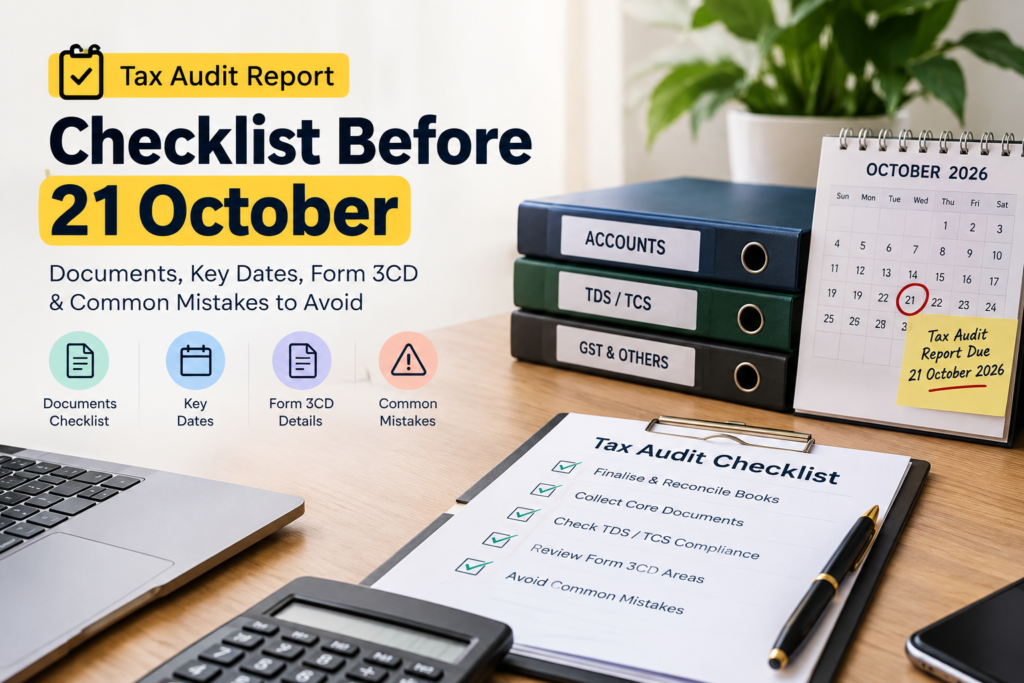
Tax Audit Report Checklist Before 21 October
The tax audit season always feels shorter than it is. Books are still being reconciled, TDS mismatches keep showing up, and the auditor is waiting on one missing confirmation. With the due date for the tax audit report for AY 2026-27 now set at 21 October 2026, there is little room for last-minute surprises.
This tax audit report checklist is for business owners, professionals, accountants and finance teams who want to close the audit cleanly and on time. It covers who needs an audit, the key dates, the documents to arrange, the main Form 3CD areas that cause problems, and the mistakes to avoid.
What Is a Tax Audit Report?
A tax audit is an examination of your books of account by a practising Chartered Accountant under Section 44AB of the Income-tax Act, 1961. The CA checks whether your books are properly maintained, whether income and expenses are correctly reported, and whether you have complied with specific tax provisions such as TDS, GST-related disclosures and loan or deposit rules.
The outcome is a tax audit report, filed electronically on the Income Tax portal in:
- Form 3CA-3CD, where your accounts are already required to be audited under another law (for example, a company audit), or
- Form 3CB-3CD, where you are not otherwise required to get your accounts audited.
Form 3CD is the detailed statement of particulars. It is the longest part of the report and where most of the work sits.
Key Dates to Remember for AY 2026-27
| Compliance | Due date |
|---|---|
| Tax audit report (Section 44AB) | 21 October 2026 (extended from 30 September 2026) |
| ITR for audit cases | 21 November 2026 (extended from 31 October 2026) |
| Transfer pricing cases (Form 3CEB) | 30 November 2026 (separate category) |
The return date moved because the audit report must be filed at least one month before the ITR due date. If you have international or specified domestic transactions, confirm your exact dates with your advisor, since transfer pricing cases follow a different timeline.
Who Needs a Tax Audit?
Before working through the checklist, confirm you are actually covered. You generally need an audit if:
- Business: Gross receipts or turnover exceed ₹1 crore in the year.
- Business with limited cash: The limit rises to ₹10 crore if cash receipts and cash payments are each 5% or less of the total.
- Professionals: Gross receipts exceed ₹50 lakh.
- Presumptive taxation: You have declared profit lower than the prescribed percentage under Section 44AD, 44ADA or 44BB and your income is above the basic exemption limit, or you opted out of the scheme and fall under the conditions of Section 44AD(4).
- Loss claims: Certain cases where losses are carried forward under the presumptive rules.
Thresholds and conditions are technical, so if you are near a limit, have the CA confirm applicability early rather than in the last week.
Tax Audit Report Checklist: Step by Step
1. Finalise and Reconcile Your Books
An audit cannot start on incomplete books. Before you hand anything to your CA:
- Close all accounting entries for FY 2025-26 (1 April 2025 to 31 March 2026).
- Reconcile bank accounts with the bank statements for every account, including dormant and overdraft accounts.
- Match the sales register to GST returns (GSTR-1 and GSTR-3B) and to the books.
- Review the debtors, creditors and loans ledgers and get balance confirmations for large or old balances.
- Complete stock valuation and keep the supporting inventory records.
- Post depreciation entries and update the fixed asset register.
2. Collect the Core Documents
Keep a shared folder ready so the auditor is not chasing you:
- Trial balance, profit and loss account and balance sheet
- Ledger accounts, cash book and bank statements
- Sales and purchase invoices and expense vouchers
- GST returns and reconciliation statements
- TDS and TCS returns (Forms 24Q, 26Q, 27Q) and challans
- Form 26AS and Annual Information Statement (AIS)
- Fixed asset register and purchase or sale documents
- Loan agreements and interest certificates
- Partnership deed, MOA/AOA or other constitution documents
- Previous year’s audit report and return copy
3. Check TDS and TCS Compliance
TDS is one of the most common sources of audit disallowances and reporting. Check that:
- TDS was deducted on every payment where it applied (contractor, professional fees, rent, commission, interest and so on).
- Deducted tax was deposited on time, and returns were filed on time.
- Payee PANs were collected, and any lower or nil deduction certificates are on file.
- Expenses where TDS was not deducted or paid late are identified, because they may attract a disallowance under Section 40(a)(ia).
Form 3CD requires the auditor to report these details, so incomplete records here will show up in the report.
4. Review Cash Transactions
Cash rules are strict, and the auditor must report on them:
- Section 40A(3): Cash payments above ₹10,000 per day to a single person can lead to disallowance of the expense.
- Sections 269SS and 269T: Loans, deposits and repayments of ₹20,000 or more must go through banking channels. Breaches are reported in Form 3CD.
- Section 269ST: Receipts of ₹2 lakh or more in cash are restricted.
List any such transactions in advance, along with the reason and supporting evidence.
5. Verify Expenses and Disallowances
Go through expenses with the same eye the Assessing Officer would use:
- Personal expenses booked in the business
- Payments to related parties and whether they are at market value
- Interest, salary and remuneration paid to partners within the limits of Section 40(b)
- Expenses paid in a different year, and the dates on which employee contributions to PF and ESI were deposited
- MSME payments outstanding beyond the allowed period, which are reported under Section 43B(h)
On the MSME point, payments to micro and small enterprises must be made within the prescribed time limit for the expense to be allowed in that year. Many businesses overlook this.
6. Check Depreciation and Capital Items
- Confirm that each asset is in the correct block and rate under the Income-tax Act.
- Verify dates of purchase and put-to-use, since a purchase after 180 days of the year gets half-year depreciation.
- Record sale or disposal of assets properly, along with capital gains impact.
7. Review Loans, Deposits and Related Party Transactions
- Collect details of all loans taken and given, including the lender or borrower PAN.
- Note the mode of receipt and repayment.
- Prepare a list of related-party transactions with the nature and amount of each.
8. Confirm GST Reporting
Form 3CD asks for the break-up of turnover or gross receipts as per GST returns and for details of input tax credit. Reconcile your books with your GST filings before the audit so differences can be explained.
9. Prepare Statutory and Compliance Details
Be ready with:
- Details of employee benefits and provident fund or ESI deposits
- Brought-forward losses and unabsorbed depreciation
- Details of deductions claimed under Chapter VI-A
- Any pending litigation, notices or assessment orders
- Quantitative details of stock for traders and manufacturers
10. Review the Draft Before the CA Uploads
Once the auditor shares the draft, do not simply approve it:
- Check your PAN, name, address and the audit period.
- Check turnover, profit and balance sheet figures against your books.
- Read the observations and qualifications, and discuss anything you do not understand.
- Make sure the CA has the correct UDIN and that the report is uploaded by the CA through the portal.
After the CA uploads the report, you must log in, review and accept (or reject) it on the Income Tax portal. A report that is uploaded but not accepted does not complete your compliance.
Common Form 3CD Areas That Cause Trouble
- Clause 21 items: Expenses disallowed under various sections, such as cash payments and payments to related parties
- Clause 26: Items deductible only on actual payment, such as employee PF contributions and MSME dues
- Clause 31: Loans and deposits accepted or repaid in cash
- Clause 34: TDS and TCS compliance details
- Clause 44: GST expenditure breakup
These are the places where records are most often incomplete, so give them extra time in your schedule.
Penalty for Missing the Tax Audit Deadline
If you were required to get your accounts audited and failed to do so, or did not file the report by the due date, Section 271B can apply. The penalty is 0.5% of total sales, turnover or gross receipts, or ₹1,50,000, whichever is lower. A penalty can be avoided only if you can show a reasonable cause for the delay.
There are other consequences too. You cannot file your ITR in the audit category until the report is filed, so delays in the audit also push back your return, refund and loss carry-forward.
A Practical 3-Week Plan Before 21 October
- Week 1: Finish reconciliations, collect missing vouchers, and send the complete document set to your CA.
- Week 2: Resolve auditor queries, clear TDS and GST mismatches, and finalise fixed assets and stock.
- Week 3: Review the draft report, correct errors, have the CA upload it, and accept it on the portal well before the final day.
Do not leave the upload for 20 or 21 October. Portal slowdowns and digital signature issues are common on the last days.
Common Mistakes to Avoid
- Starting the audit only after the books are half-finished
- Ignoring small TDS defaults that add up to large disallowances
- Not reconciling GST returns with books
- Forgetting to accept the report on the portal after the CA uploads it
- Assuming the extension applies to every case, including transfer pricing
- Mixing up the audit report due date with the ITR due date
Frequently Asked Questions
What is the due date for the tax audit report for AY 2026-27?
The due date has been extended to 21 October 2026 from the original 30 September 2026.
What is the new ITR due date for audit cases?
It is 21 November 2026 for taxpayers whose accounts are subject to audit.
Who has to get a tax audit done?
Businesses with turnover above ₹1 crore (₹10 crore if cash transactions are within 5%), professionals with receipts above ₹50 lakh, and certain presumptive taxation cases.
Which form is used for the tax audit report?
Form 3CA-3CD if you are already audited under another law, and Form 3CB-3CD otherwise.
What is the penalty for not getting the audit done on time?
Under Section 271B, it is 0.5% of turnover or ₹1.5 lakh, whichever is lower.
Do I have to accept the report on the portal?
Yes. After the CA uploads the report, the taxpayer must review and accept it on the Income Tax portal.
Can I file my ITR before the audit report is filed?
No. In audit cases, the ITR can be filed only after the report has been furnished.
Final Thoughts
A good tax audit is less about the final week and more about the preparation in the weeks before it. Use this tax audit report checklist to organise your books, close compliance gaps and give your CA what they need early. With the deadline set at 21 October 2026, start now so that your report and ITR both go through without penalty or stress.