


Ask Question?

Fill up form below, our team will get back soon

ITR Filing for Salaried Employees in Delhi 2026 | Documents, Deadlines & Process

For professionals getting salary in private firms, govt organizations and MNCs in Delhi, the process of Income Tax Return filing or simply ITR filing is not at all an annual necessity in the coming year 2026. It is the medium which will ascertain the possibility of whether you will receive any amount in the way of refunds, whether you are eligible to apply for your home or personal loans or you will be summoned for any inquiries.

This article comprises of complete details relating to salaried income ITR filing process in one article and here individuals working in private sector, govt organizations or MNCs in Delhi or entire NCR can know whatever they are required to know.

It is all about ITR filing for salaried income and the individual whose earnings are in the form of single or multiple sources, have some source of investment income, claim for HRA and other tax deductions will find the article extremely helpful.


What Is an ITR for Salaried Employees?

The Income Tax Return (ITR) filed by a salaried employee is basically the statement whereby the individual furnishes all necessary details of income earned from salary, house property, capital gain or any other source during a particular year, as well as the tax payable as a result of this income, to the Income Tax Authorities. Through the ITR, the salaried individual gets a chance to declare his earnings accurately as well as avail all applicable deductions or exemption provisions under the relevant Income Tax law. The ITR filing requirement applies to all salaried employees after crossing a certain prescribed income level, whether or not tax deduction has occurred on salary payment by the employer.

The Four Core ITR Filing Services Every Salaried Employee Needs

ITR Filing for Single Employer Income

Matching Form 16 data with income, making a claim for standard deduction, HRA, and other exemptions.

ITR Filing for Multiple Employers/Job Changes

Merging of one’s income and TDS from various employers in one particular year into a single correct return.

ITR Filing With Deductions & Investments

Deductions under the following Sections 80C, 80D, etc. can be claimed for investments made.

ITR Filing for Salaried Employees With Additional Income

Reporting salary in conjunction with rent, capital gain or interest income on the right schedule in the ITR form.

Why ITR Filing for Salaried Employees Matters in 2026

Examples of some changes which have affected ITR filing for salaried employees in 2026 include:

Use of pre-filled form will depend on the Form 16 furnished by the employer, TDS and AIS/TIS; this implies that there will be an automatic mismatch between the data supplied by the employer and the ITR being filed.


There is intensive scrutiny of various claims made under the different sections. As such, individuals must keep evidence related to their investment and expenses on yearly basis.


There will be a matching process of data filed in the ITR forms and Form 16, bank interest certificates and capital gain data. In this case, there will be issuance of a tax notice within weeks in case of any disparity.

For those who earn from a new job or salary and earn rental or other incomes and/or have capital gains from the investments along side the salary income, the proper filing of ITR form is very important.

This helps in reconciling income from all sources.

Benefits of Staying ITR Compliant as a Salaried Employee

data

No late fees, interest, or penalty notices that eat into your annual savings.

planning

Faster loan and credit card approvals, as banks assess your ITR filing history before sanctioning home, vehicle, or personal loans.

streamlined-connectivity

Smoother visa applications, since ITRs are routinely required as proof of income.

money

Ability to carry forward capital losses from investments to future profitable years.

Trusted by 100+ Companies

Step-by-Step: The ITR Filing Journey for a Salaried Employee

Step 1: Collect Your Documents

Your documents should include the following: PAN, Aadhaar, Form 16/16A, bank statements, investment proofs, rent receipts (if claiming HRA), and details of any additional income sources.

Step 2: Choose the Right ITR Form

The correct form depends on whether you have only salary income, or additional income from house property, capital gains, or other sources.

Step 3: Reconcile with Form 16 and AIS/Form 26AS

Before filing, cross-check your reported income and TDS against Form 16, AIS, and Form 26AS to avoid mismatches that delay processing.

Step 4: File and Verify

Submit your return online, claim eligible deductions and exemptions, and complete e-verification within the prescribed window — an unverified return is treated as not filed.

Common Mistakes to Avoid

Filing under the wrong ITR form

Using a form that doesn't match your income sources can render the return defective.

Not reconciling with Form 16 and AIS/Form 26AS

Mismatches between employer-reported income and self-reported income are now caught almost immediately.

Missing the filing deadline

Late filing brings interest and penalty charges, and repeated delays can invite scrutiny.

Forgetting to e-verify after submission

An unverified ITR is treated as not filed at all, even if you submitted it on time.

ITR Filing Deadline for Salaried Employees

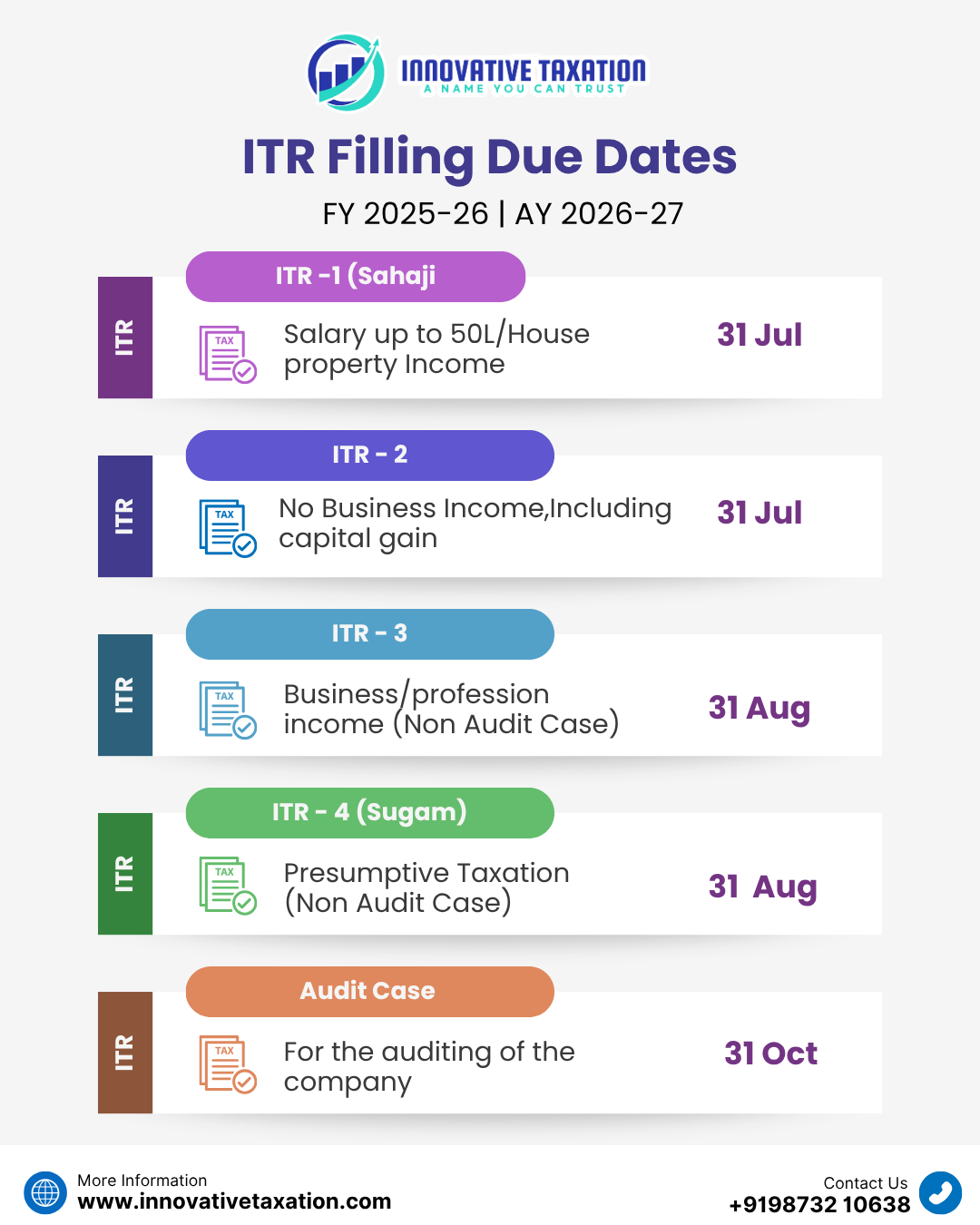
Salaries of individuals whose accounts do not demand an audit can file their ITR by 31st July. There is also a penalty that will be imposed as per Section 234F in case of failure to file ITR on time, and there will also be an addition of interest in this regard.


ITR Filing Services Comparison Table

  • ITR Filing for Single Employer:  Income Every financial year, before 31 July 2-3 working days
  • ITR Filing for Multiple Employers/Job: Changes Income and TDS from more than one employer 3-4 working days
  • ITR Filing With Deductions & Investments: Claiming deductions under 80C, 80D, and others 2-3 working days
  • ITR Filing With Additional Income: Salary plus rental, capital gains, or interest income 4-6 working days
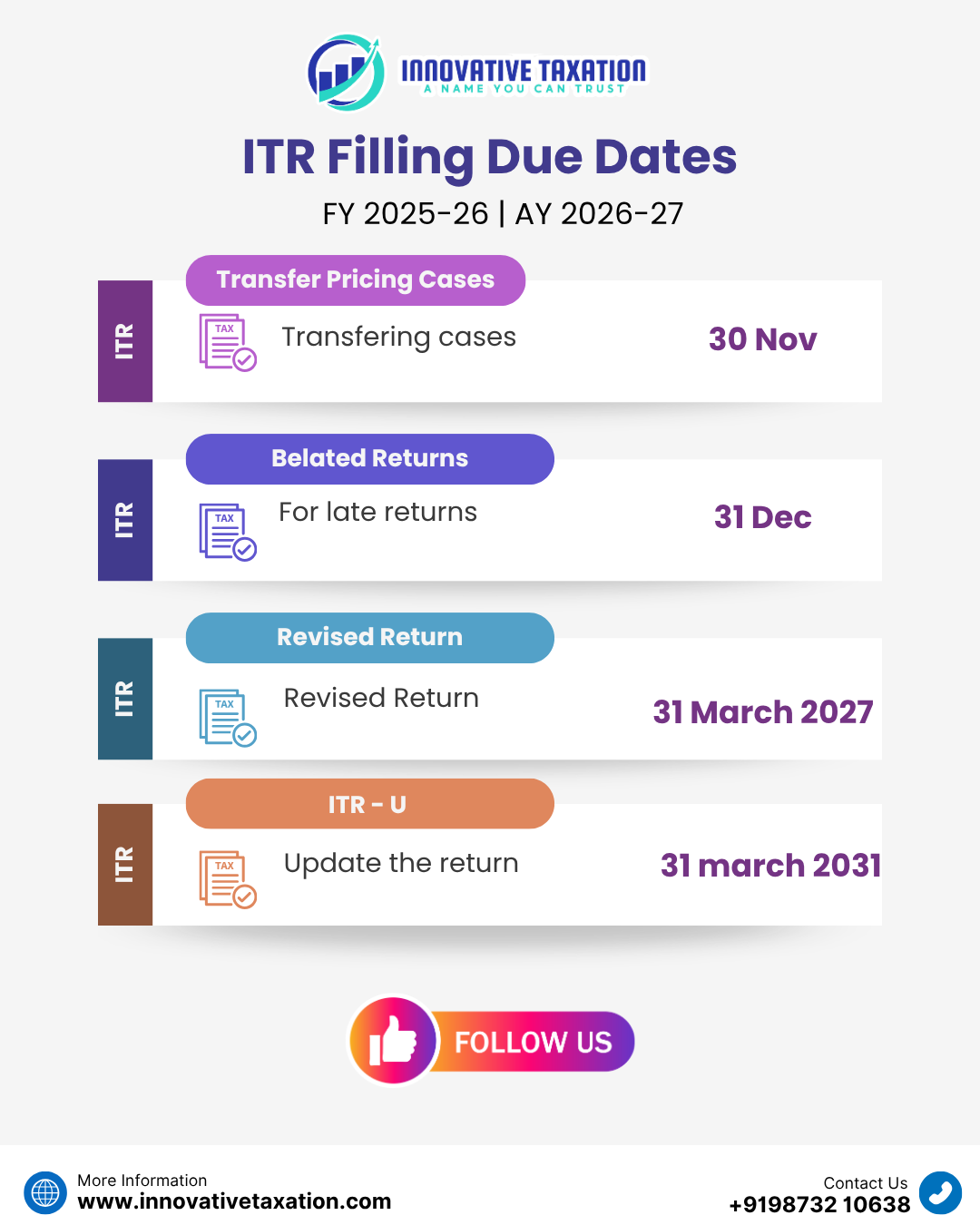
  • ITR(U) / Updated : Return Correcting or updating a previously filed/missed return 3-5 working days

Let Us Help You!!

Frequently Asked Questions

Who needs to file an ITR as a salaried employee?

Any salaried employee whose income crosses the prescribed threshold must file an ITR annually, even if the employer has already deducted TDS on the salary.

Yes, TDS deduction doesn’t replace ITR filing — it’s a separate requirement, and filing is also how you claim any excess TDS as a refund.

Yes, e-filing is mandatory for most taxpayers, including salaried employees — it’s secure, trackable, and reduces processing time.

The employee may face a late filing penalty under Section 234F, interest on unpaid tax, and could lose the ability to carry forward certain losses.

Technically yes for simple, single-employer income, but with job changes, multiple deductions, or additional income sources, professional guidance helps avoid errors, missed deductions, and notices.

Ask Question?

Fill up form below, our team will get back soon

What Our Clients Says

4.9 rating across 100+ Google Reviews

Get Latest Updates On GST

From Govt. New Rule to the blogs on saving taxes

Scroll to Top